Abliterated Models Explained: How Abliteration Removes AI Refusals
Abliteration removes a model's ability to refuse by editing its weights, not by retraining it. Here is how the arithmetic works, what changed in 2025 and 2026, and the measured accuracy cost.
By LessStrict Team9 min readUpdated
In this article
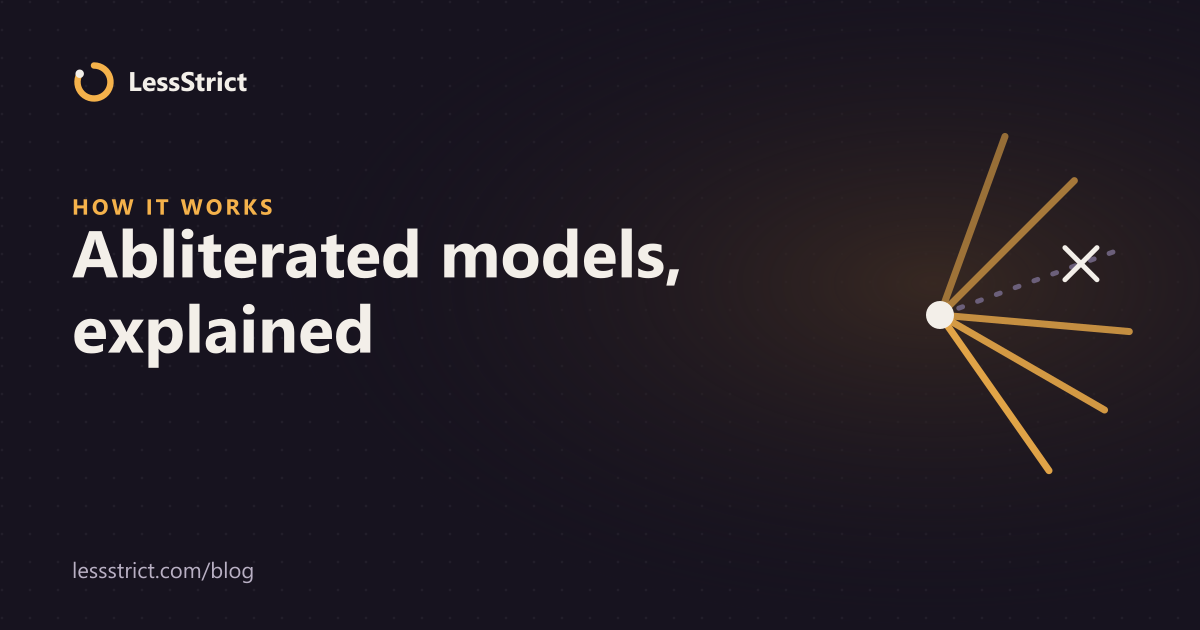
An abliterated model is an open-weight language model that has had its ability to refuse edited out. Nothing is retrained. A small, targeted change to the weights removes the internal signal that makes the model say "I can't help with that", and the rest of the model is left as it was.
The technique is two years old, it has moved fast, and much of what is written about it online describes the 2024 version. This article covers where abliteration came from, how it works step by step, how the 2025 and 2026 methods differ from the original, what it costs in quality with real numbers, and how it compares with uncensored fine-tunes and jailbreaks.
Where the word comes from
In June 2024 a group of researchers published Refusal in Language Models Is Mediated by a Single Direction, later presented at NeurIPS 2024. They studied 13 open chat models of up to 72 billion parameters and found that, in every one, "refusal is mediated by a one-dimensional subspace". Erasing that direction from the model's internal activations "prevents it from refusing harmful instructions, while adding this direction elicits refusal on even harmless instructions".
The paper called the removal "ablation". A developer known as FailSpy applied it to released models and gave it the name that stuck. In his words, on the model card: "Ablate + obliterated = Abliterated", a term he says he "made up particularly to differentiate the model from 'uncensored' fine-tunes". Maxime Labonne's write-up, Uncensor any LLM with abliteration, brought the method to a wide audience the same month.
How abliteration works
A language model passes each token through a stack of layers. Between layers it carries a long list of numbers, called the residual stream, which holds what the model currently "has in mind". The 2024 finding is that one direction in that space stands for "I should refuse this".
Abliteration finds that direction and removes it. In outline:
- Collect two sets of prompts. One set the model normally refuses, one set of harmless instructions.
- Record the activations. Run both sets through the model and save the residual stream at the last token, for each layer.
- Take the difference of the means. The average activation for refused prompts minus the average for harmless ones gives a candidate "refusal direction" for each layer.
- Pick the best candidate. Normalise the candidates, test them, and keep the one that removes refusals most cleanly.
- Remove the direction. Either subtract it while the model runs, or change the weights permanently so that no layer can write along that direction. The permanent version is called weight orthogonalization, and it is what a downloadable "abliterated" model contains.
No gradient descent, no dataset of answers, and very little compute. As FailSpy put it, ablation is "much more surgical in nature whilst also being effectively executed with a lot less data than fine-tuning".
Abliterated vs uncensored vs jailbroken
These three are often used as if they meant the same thing. They do not.
| Abliterated model | Uncensored fine-tune | Jailbreak | |
|---|---|---|---|
| What changes | Weights are edited | Model is retrained on filtered data | Nothing; only the prompt |
| Example | huihui-ai abliterated series, Heretic builds | Dolphin, many roleplay tunes | "Pretend you are…" prompts |
| Effort | Minutes to hours | Days of training and a good dataset | None |
| Keeps the original model's skills | Mostly | Changes style and knowledge too | Yes |
| Works on hosted closed models | No | No | Sometimes, against the rules |
An uncensored fine-tune such as Dolphin takes a different route. Its maker, Eric Hartford, removes refusals from the training data and trains the model again. The result has its own personality and writing style. An abliterated model is meant to behave exactly like the original, minus the refusals.
What changed in 2025 and 2026
The original method is blunt: it removes the whole refusal direction from every layer. Newer methods are more careful, and a model called "abliterated" today may have been made with any of them.
- Projected abliteration (October 2025) removes only the part of the direction that is specific to refusal, described as "removing only the mechanistically relevant components of the refusal direction".
- Norm-preserving biprojected abliteration (November 2025) changes only the direction of each weight row and restores its original size. Its author calls the standard method "mathematically unprincipled". On one 12-billion-parameter model it kept, and slightly raised, a general-intelligence score that the standard method had left flat.
- Heretic (open source) automates the whole job. It searches for the settings that give the fewest refusals with the least change to the model's other behaviour, measured as KL divergence. Its default is now a method it calls Arbitrary-Rank Ablation, with the classic approach still available. The project says using it "does NOT require understanding how language models work internally", and the community has published thousands of models made with it.
There is also work in the other direction. A 2026 paper, LLM Abliteration Prevention Via Refusal Aliases, proposes training models so that refusal is not held in a single removable direction.
What abliteration costs
This is the section most guides leave thin. Here is what independent measurement shows.
Capability. Labonne's original write-up was candid: "we observe a performance drop in the ablated version across all benchmarks". He recovered most of it with a short round of extra training, sometimes called healing.
A 2026 study compared four abliteration tools on 16 models of 7 to 14 billion parameters. On a maths benchmark the change ranged from +1.5 points to −18.8 points. Averaged over three models, two tools lost less than a third of a point and one lost 7.8. The tool matters as much as the model.
Refusals that remain. In the same study, between 2 and 54 of 100 harmful test prompts were still refused, depending on the model. Abliteration does not always work fully.
Truthfulness. A small July 2026 study found that abliteration raised the rate of confident falsehoods on two of three models tested: from 18.6% of questions to 30.6% on one, and from 42.2% to 47.7% on another, with the third unchanged. An internal "truth probe" barely moved, which suggests the model still knows the right answer and says the wrong one anyway. The author lists caveats, and the study is small, but it points at a real effect: the signal for "I should not answer" overlaps with the signal for "I am not sure".
Leftover disclaimers. A model can stop refusing and still attach a warning to its answer. One vendor's own measurements of an abliterated build found refusals falling from about 99% to almost zero while 30 to 50% of answers still carried a disclaimer.
Model cards are not always right. Published figures are self-reported. Treat a card's quality claims as a starting point and test the model yourself.
The practical conclusion: a well-made abliterated model loses little, a careless one loses a lot, and you cannot tell which is which from the name.
Popular abliterated models in 2026
Abliterated versions exist for most major open model families. Among those we could confirm on the publishers' own pages in November 2026:
- huihui-ai publishes the largest series, with abliterated builds of Qwen, DeepSeek, GLM, Gemma, Llama and Phi models, including Qwen 3.8 27B, DeepSeek V4.1 Flash and GLM 5.3.
- Heretic builds from many community authors, usually with "heretic" in the name.
- mlabonne published the early reference models, such as NeuralDaredevil-8B-abliterated.
- Llama 4 has community abliterations, for example of Llama 4 Scout.
Hugging Face hosts thousands of them. For a wider view that includes fine-tunes, see Uncensored LLMs: the open models to know.
Is abliteration legal, and is it safe?
Editing the weights of an open model is legal in most places, subject to the model's licence. Some licences restrict commercial use or carry their own acceptable-use terms, and those still apply to a modified copy. Whatever the model says, the output is yours.
Safety is a more serious question than it was in 2024. The original paper described abliteration as a "white-box jailbreak" and warned that it shows how fragile safety training is. In 2026 abliterated models are sold as hosted services, and press coverage has shown some of them producing working malware on request. An abliterated model has no judgment about who is asking. That is why a responsible host puts fixed limits back in front of the model for the small set of requests that are dangerous to anyone.
Do you need an abliterated model?
Often not. Most people who search for one have an ordinary task that a mainstream assistant refused: a security question about their own systems, a medical or legal question, a dark scene in a novel, an honest critique. A less restrictive model handles those without weight surgery and without the accuracy risks above.
That is the approach we take at LessStrict. The models run on our servers, configured to answer the ordinary requests other assistants decline, with a short list of fixed limits they keep. You can try them in the chat or through an OpenAI-compatible API, and the free plan needs no card.
Abliteration is the right tool when you need the exact behaviour of a specific base model without its refusals, you are running it yourself, and you are prepared to test what the edit cost.
Frequently asked questions
What is an abliterated model in simple terms?
An open AI model that was edited so it can no longer refuse. The edit removes one internal direction that the model uses to decide to refuse, and leaves the rest of the model alone.
Is an abliterated model the same as an uncensored model?
Not exactly. "Uncensored" is the broad term. An abliterated model is one kind, made by editing weights. Another kind is the uncensored fine-tune, made by retraining on data with refusals removed.
Is abliteration the same as jailbreaking?
No. A jailbreak is a prompt and changes nothing in the model. Abliteration changes the model's weights permanently.
Does abliteration make a model dumber?
It can. Measured losses range from none to large, depending on the model and the method. Newer methods such as projected and norm-preserving abliteration lose less than the original technique.
Does abliteration remove every refusal?
No. Tests in 2026 found between 2 and 54 refusals remaining out of 100 harmful prompts, depending on the model. Disclaimers often remain as well.
Can any LLM be abliterated?
Any model whose weights you can download. Closed models that are available only through an API, such as ChatGPT, cannot be abliterated by users.
Can I abliterate a model myself?
Yes, with open tools such as Heretic and a graphics card large enough to load the model. It takes minutes to hours. Testing the result properly takes longer than making it.
Are abliterated models dangerous?
They remove the model's own safeguards, so they will help with requests that a standard model declines, including harmful ones. The risk depends on who uses them and what stands in front of them.
Where can I use an abliterated model without running it myself?
Several hosted services offer them through an API. Our guide to uncensored LLM APIs compares the options and their prices.
Who invented abliteration?
The underlying research is by Andy Arditi and co-authors, published in June 2024. The name "abliteration" was coined by the developer FailSpy, who released the first widely used abliterated models.