How Open Source LLM APIs Compare on Cost and Control
Compare open source LLM APIs by real cost, control, hosting model, and license terms to choose the best fit for your workload.
By LessStrict Team8 min read

In this article
Open source LLM APIs promise two things that teams care about right away: lower cost and more control. Both can be true. Neither is automatic.
That is the part many buyers miss. An open model can sit behind a hosted API that feels almost identical to a closed commercial service, complete with per-token billing, provider-side policies, and limited visibility into runtime choices. The same model can also be self-hosted on your own infrastructure with far more control over data flow, scaling, and system behavior. The difference is not the label “open source.” The difference is the deployment model, the license, and the operational choices around it.
Open source LLM API cost depends on how the model is delivered
When teams compare open source LLM APIs, they often start with a simple question: “What does one million tokens cost?” That number matters, but it is only one layer of the bill. Open models can be sold through shared APIs, dedicated endpoints, or self-hosted inference stacks, and each option produces a very different cost profile.
A shared hosted API usually looks familiar. You send chat-completions requests, and you pay by input and output tokens. This model is easy to test, easy to budget at low volume, and quick to plug into existing tools. It also shifts a lot of control to the provider, including routing, rate limits, model updates, and sometimes moderation policies.
Dedicated hosted endpoints change the math. Instead of buying only tokens, you are renting compute. Official Hugging Face Inference Endpoints documentation describes pricing by instance type, with rates shown per hour and billed by the minute. Those endpoints run on dedicated infrastructure, and charges apply while an endpoint is initializing or running. That means idle time, startup time, and instance selection can matter almost as much as prompt length.
Self-hosting creates a third model. Here, the token price is no longer given to you. You create it yourself by combining hardware cost, utilization, engineering time, power, storage, monitoring, and uptime requirements. If utilization is high and workloads are steady, self-hosting can be very attractive. If traffic is bursty, small, or unpredictable, it can be more expensive than it first appears.
| Deployment option | Common pricing model | Control level | Main cost risk | Best fit |
|---|---|---|---|---|
| Shared hosted open source API | Per-token | Medium | Output-heavy workloads can spike bills | Fast testing, small teams, variable usage |
| Dedicated hosted endpoint | Per-hour or per-minute compute rental | Medium to high | Paying for warm or idle infrastructure | Stable traffic, latency-sensitive apps |
| Self-hosted inference server | Your own hardware or cloud bill | High | Underused GPUs and ops overhead | High volume, strict data or runtime control |
The best choice often comes down to utilization. If you keep a GPU busy, self-hosting can look efficient. If you do not, a token-priced API may be the smarter move even at a higher apparent unit rate.
Hosted open source LLM APIs and dedicated endpoint pricing
Hosted open source LLM APIs are attractive because they remove the hardest early work. You do not need to benchmark GPUs, tune schedulers, patch drivers, or run a serving stack. You get a model that is already live behind an endpoint, often with SDK support and OpenAI-style request formats.
But hosted does not always mean “cheap.” Dedicated endpoints, in particular, can cost more than expected if the team assumes usage-based economics while actually renting always-on capacity. According to the Hugging Face pricing documentation, billing is based on the instance type selected, displayed per hour, and charged by the minute. Even their low-end CPU instance examples show how pricing begins before any serious throughput enters the picture.
That pricing structure is not bad. It simply rewards a different usage pattern. A team with steady production demand may prefer predictable dedicated compute over token volatility. A team doing occasional tests may pay for idle time that delivers little value.
A few variables tend to shape hosted open source LLM API bills more than expected:
- Prompt size
- Output size
- Endpoint uptime: dedicated infrastructure may incur cost while initializing or waiting for requests
- Model size: larger models usually require more expensive instances
- Concurrency demand: higher simultaneous traffic can force a move to bigger hardware
This is why “open model” and “low cost” should never be treated as synonyms. A provider may host an open model on premium GPUs with strong uptime targets, and the price will reflect that choice.
Self-hosted open source LLM APIs give more runtime control
If cost is only one side of the decision, control is the other. Self-hosting changes what your team can shape.
The clearest example is API compatibility without provider lock-in. The official vLLM documentation describes running an inference server that implements the OpenAI API protocol and can serve as a drop-in replacement for applications already built around that format. By default, it starts on http://localhost:8000, and clients can send chat and completion requests in the same general style they already use elsewhere.
That detail matters more than it may seem. OpenAI-compatible serving means a team can keep its application layer relatively stable while changing what sits behind the API. You can test models, tune throughput, change context settings, manage caching, or place the system inside your own network boundary without rewriting every integration.
Self-hosting also changes where observability lives. Instead of asking a provider what happened, you can inspect logs, queue times, token throughput, hardware saturation, and latency distributions directly. That can improve both cost control and service quality.
That broader governance issue also appears in Tow’s look at a self-hosted AI workspace for secure operations, which treats private deployment as a question of auditability and access control as much as model hosting.
Still, self-hosting is not “free control.” It comes with real work. Someone has to patch systems, rotate keys, manage autoscaling, handle failures, and keep model deployments predictable. Small teams should treat operations as part of the price, not as an invisible bonus.
Open source LLM licenses define another layer of control
There is also a quieter question behind every open source LLM API decision: what are you actually allowed to do with the model?
People often use “open source” as a broad category, but model licenses differ a lot. Some licenses are very permissive. The Apache 2.0 license, for example, grants broad rights to reproduce, modify, sublicense, distribute, and use derivative works, while requiring preservation of notices and clear marking of changes. That is a wide operating envelope.
Other model licenses are more limited. Meta’s Llama license grants broad use rights, but it is still a royalty-free limited license with conditions. Distribution requires inclusion of the agreement and attribution notice, use must comply with an acceptable use policy, and the license restricts using Llama outputs to improve other large language models outside the allowed scope. Those terms may be reasonable for many teams. They are not the same thing as unrestricted freedom.
This is where “control” becomes more precise. Control is not only about where the server runs. It is also about:
- Modification rights: whether you can fine-tune, adapt, and redistribute the model
- Commercial rights: whether business use is unrestricted or subject to added terms
- Attribution duties: whether notices, license files, or branding language must be preserved
- Use-policy limits: whether certain categories of use are contractually blocked
A permissive infrastructure setup cannot override a restrictive model license. You may fully control your server and still face real limits on distribution, training use, or product packaging.
API compatibility matters almost as much as price
There is a practical reason many teams gravitate toward open source LLM APIs instead of raw model files: integration cost.
If an API matches the chat-completions shape used by existing tools, the switching cost drops fast. You can compare models inside the same application, move traffic between providers, or keep one hosted option as a fallback while bringing another model in-house. That flexibility is a form of control because it reduces dependency on a single vendor’s SDK, request format, or dashboard logic.
Platforms built around open-source models often compete here. Some, including LessStrict, present open-source models through standard chat-completions style interfaces while listing transparent per-token pricing and auditable request usage. That kind of packaging can be useful for teams that want faster adoption than self-hosting but still care about model choice and clearer billing.
The operational question is simple: do you want to control the model, the infrastructure, the API layer, or all three? Many teams only need strong control over one layer, and paying for total ownership would be wasteful.
How to compare open source LLM API cost and control in practice
A good evaluation process starts by separating “cheap,” “predictable,” and “controllable.” They overlap, but they are not the same thing.
Cheap means low total spend for your workload. Predictable means your bill is stable enough to budget with confidence. Controllable means you can shape deployment, data handling, model selection, runtime settings, and policy exposure in ways that matter to your product.
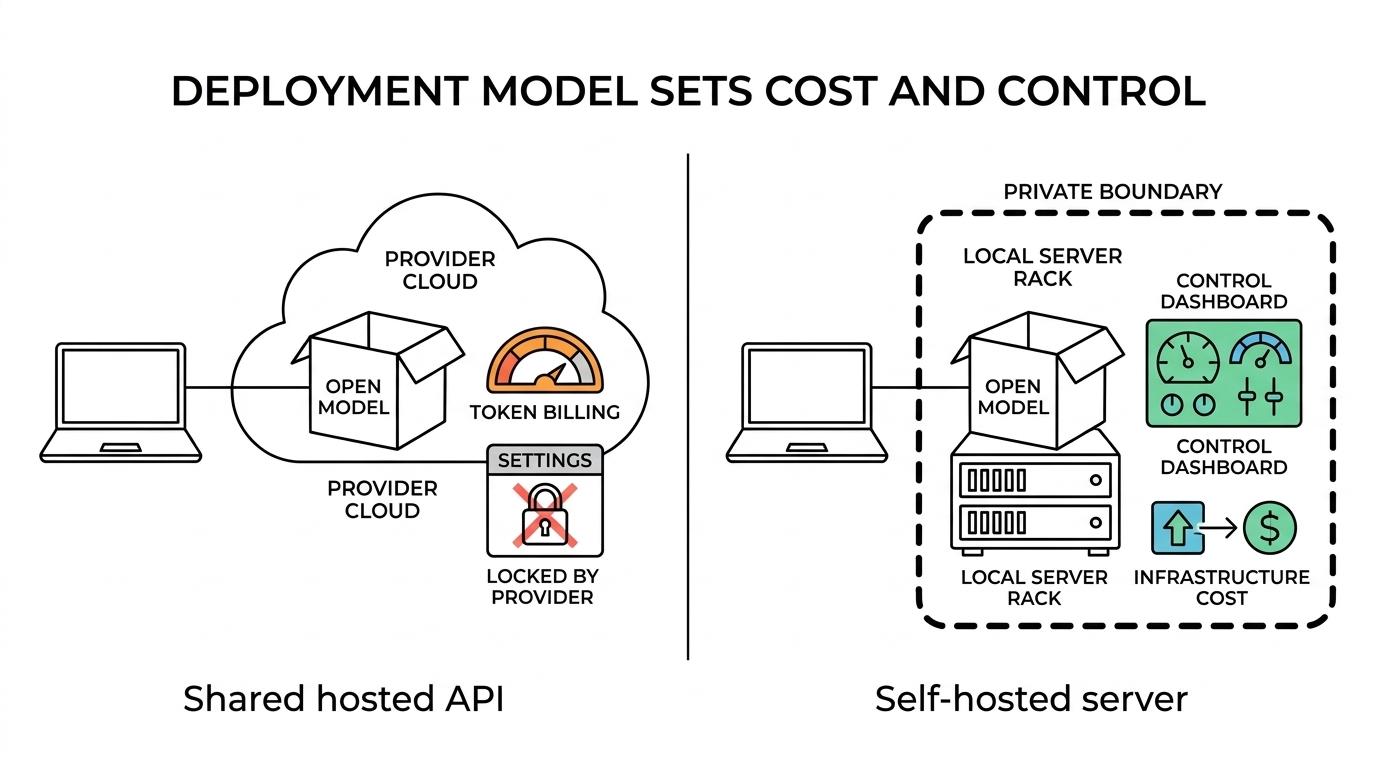
When teams make this explicit, the comparison gets easier.
- If traffic is light: shared per-token APIs are often the fastest and safest choice
- If latency must stay tight: dedicated endpoints can justify their always-on cost
- If data boundaries are strict: self-hosted or tightly controlled private deployments make more sense
- If portability matters: OpenAI-compatible servers and APIs reduce switching friction
- Short licenses with clear permissions
- Transparent usage logs
- Measurable throughput
- Exit options
One more point deserves attention: output pricing can dominate costs in real usage. A model that looks inexpensive on input tokens may become costly if your application produces long answers, tool calls, or structured JSON on every request. Testing with realistic prompts is far more useful than comparing headline rates.
Open source LLM APIs work best when the workload is clearly defined
The strongest results usually come from matching the deployment model to the workload instead of chasing an abstract idea of openness.
A coding assistant used all day by an internal engineering team may justify dedicated or self-hosted infrastructure. A research workflow with unpredictable bursts may do better on token-priced hosted APIs. A customer-facing app with strict procurement, logging, and data-location needs may benefit from an OpenAI-compatible private serving layer backed by open models. Each of these can be a sound choice.
Open source LLM APIs are powerful because they widen the decision space. You can buy convenience, rent dedicated compute, or run the stack yourself. You can choose a permissive license, or accept a model-specific license with clear tradeoffs. You can keep your client code stable while changing the backend. That flexibility is the real value.
The teams that get the most from open source LLM APIs are rarely the ones chasing the lowest sticker price. They are the ones that know which kind of control matters, which costs are fixed versus variable, and which license terms shape the product long after the first API call.